The First Lunar Spaceport.
We are not going to the Moon merely to visit a destination. We are building the infrastructure that turns the Moon into a destination.
No single reactor, robot, cave or landing pad is the Moonport. PORTUS LUNARIS is an integrated infrastructure program intended to let different machines, suppliers, missions and eventually people operate through shared services and explicit interfaces. UMBRA provides the governed operational/control architecture that keeps authority, policy, telemetry, verification and receipts intact as those workers change.
We do not know what we do not know until we map it.
Each PORTUS LUNARIS system has a job, an evidence boundary and a decision it is responsible for informing. UMBRA governs how capabilities are exposed and coordinated; PENUMBRA keeps the accountable human in view. Tap any system to open it.
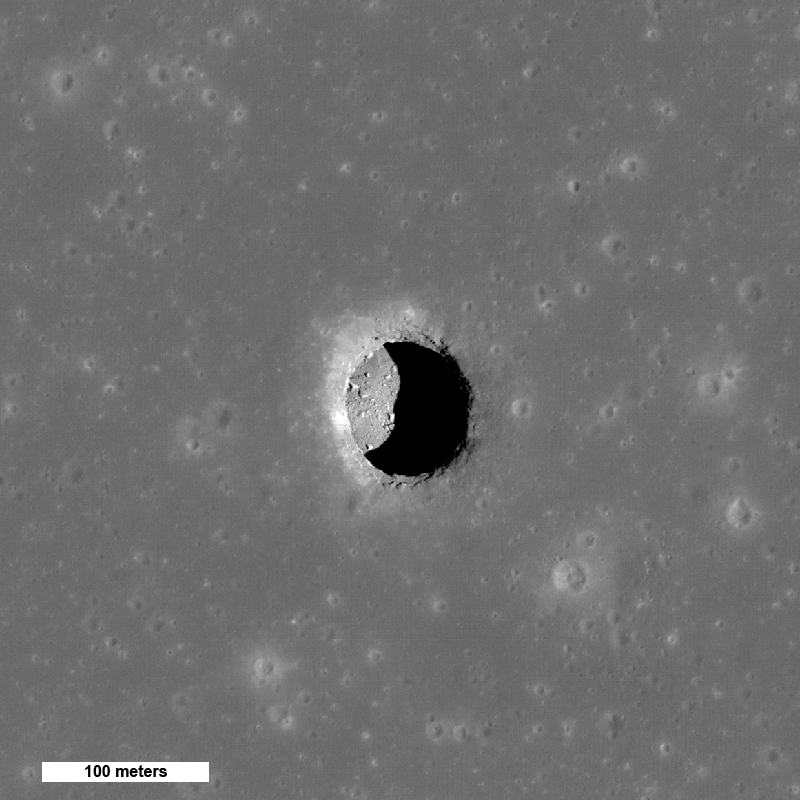
Mare Tranquillitatis Pit.
PORT-T currently centers engineering research on the Mare Tranquillitatis Pit region at approximately 8.3355°N, 33.222°E.
What we know now
The pit is a confirmed lunar skylight/collapse feature with a large opening, steep walls, overhang/recess geometry and visible interior floor sectors. It is already worth serious reconnaissance.
What we do not yet know is just as important: full subsurface geometry, roof thickness, continuity, structural competence, access difficulty and best long-term use.
Map first. Build second.
Nothing irreversible goes down the throat until ARGUS has mapped the throat.
ARGUS goes in to answer the question before UMBRA-governed port operations assign the answer. If the volume is best for people, protect it. If it is best for equipment, use it. If it is unsafe or low-value, build outward and keep the port moving.
The machines must be able to work when Earth cannot drive them.
PORTUS LUNARIS is being designed around autonomous local operation under communications delay, interruption and uncertain terrain. Earth supplies objectives and bounded supervisory direction; local systems must sense, act, preserve evidence, fail safely and recover without pretending a distant operator is sitting in the cab.
Prove the interfaces before shipping the hardware.
The first PORTUS LUNARIS proving ground is terrestrial: integrated robotics, navigation, communications, material handling, landing-infrastructure experiments and emulated power/thermal interfaces under deliberately degraded operating conditions. Specialized vacuum, dust, thermal and reduced-gravity questions require specialized test environments rather than pretending one Earth facility reproduces the Moon.
Build outward from the unknown.
Landing zones, power, radiators, material processing, logistics routes and protected operations are separate engineering decisions. Unique lunar volume is preserved until evidence establishes its best use.
Failure must not kill the program.
If one candidate pit, machine, process or supplier fails qualification, PORTUS LUNARIS continues. The program is designed around replaceable components, bounded authority and progressive evidence, while UMBRA keeps the governance architecture intact.
PORTUS LUNARIS is seeking conversations with researchers, space operators, robotics teams, energy and thermal engineers, materials specialists, civil/construction automation groups, sensing and metrology teams, communications specialists, manufacturers and suppliers interested in discrete Earth-testable demonstrators that can mature toward lunar use.