A single chat window can find a cheesecake recipe, summarize a document, draft an email, or generate some code. That is useful. It is not an operating model.
The model breaks when AI stops being an occasional assistant and becomes a digital workforce. Through NULLWORKS, I accumulated hundreds of active and archived work threads and a growing collection of specialized roles across research, implementation, continuity, quality review, security boundaries, public translation, artifact production, project coordination, and domain-specific workflow design.
Individually, the specialists were useful. Collectively, they created a new problem: how does one human know who owns what, what has already been completed, which source is authoritative, where work was duplicated, what failed, and which decisions remain unresolved?
I did not organize the agents because they needed managers. I organized them because I did.
The organization became the interface
NULLWORKS began developing executive, project, and specialist layers because the work exceeded my working memory. The titles were never intended to pretend that agents are people. They became compact human-readable handles for responsibility, authority, specialization, continuity, escalation, review, and handoff.
Instead of asking one universal assistant to remember and perform everything, work could be routed through an operating structure. Operations could classify and assign incoming work. Quality could challenge assumptions and detect waste. Continuity could preserve decisions, failures, and unfinished work. Security could protect authority boundaries. Specialists could execute bounded tasks without silently becoming final decision-makers.
The executive layer did not exist to control the agents for its own sake. It existed to protect the human operator from coordination collapse.
The current public NULLWORKS structure
Mason remains the founder, brainstem, and final human authority. NULLWORKS NEURAXIS is the persistent company brain and nervous system: it compiles context, routes missions, coordinates live work, and returns truth-state receipts. Corporate WiFi holds the canonical-memory role for sources, decisions, corrections, failures, known unknowns, and reusable company state. Its operational health is never assumed; it remains receipt-gated.
The Boardroom handles priorities, conflicts, escalation, approvals, and company-level interpretation. Named executive functions cover operations, quality, long-range pattern recognition, continuity, artifact execution, security boundaries, public intelligence, and human-state telemetry. Scoped workrooms contain project context. Temporary specialist tentacles execute bounded missions and report back through NEURAXIS rather than creating independent canon.



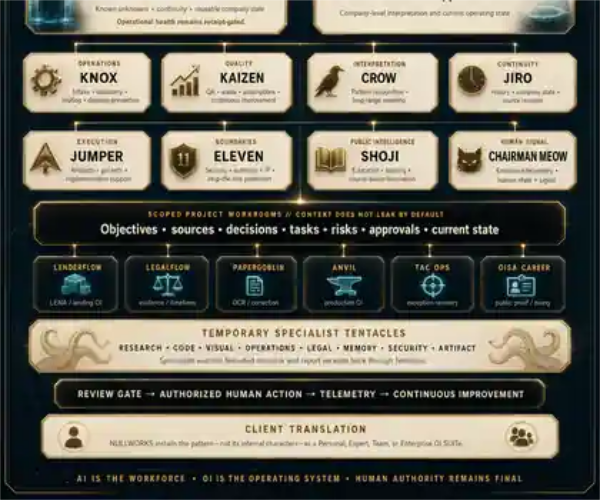
A digital Toyota
The closest analogy is not a chatbot company. It is a Toyota-style production system. Toyota did not become exceptional by finding one worker capable of building the entire vehicle alone. It created visible work cells, standard handoffs, quality controls, feedback loops, clear ownership, and the authority to stop the line when something was wrong.
A useful digital workforce needs similar properties. More agents without structure do not automatically create a smarter company. They can create faster chaos: duplicated research, missing work, authority drift, context contamination, invisible failures, and outputs that no one owns.
Classify intake, assign ownership, route work, track state, and prevent requests from disappearing between conversations.
Challenge assumptions, inspect evidence, detect waste, compare outputs, and stop work that is fluent but unsupported.
Preserve decisions, corrections, sources, failures, unfinished work, and the latest authoritative state across projects.
Make it explicit what each person, agent, tool, or workflow may investigate, draft, execute, approve, or escalate.
Give projects scoped objectives, evidence, context, tasks, owners, risks, outputs, and open loops instead of one polluted global memory.
Turn corrections, retries, delays, failures, handoffs, outcomes, and value created into an operating record that can improve.
Coordination becomes the product
Once useful specialists multiply, model intelligence is no longer the only constraint. The operating questions become more important: who owns the task, which context is shared, which context is protected, who can call which tool, what happens when agents disagree, where the source receipt lives, and who authorizes action?
Companies are beginning to encounter this problem as they add copilots, internal assistants, automations, agent frameworks, retrieval systems, workflow tools, and employee-created AI processes. Each may create local value. Together they create a system that somebody must make understandable.
At some point, an AI assistant stops being a tool and becomes an organization that needs an operating system.
I call that operating layer Operational Intelligence. The next Field Note describes the OI SUITe: the human interface connecting the digital workforce, sources, workrooms, authority, continuity, quality gates, and telemetry.